From the Desk of Our CIO
The Weather Front: How a Super El Niño Is Repricing Agricultural Commodities
|
|
|
|
|
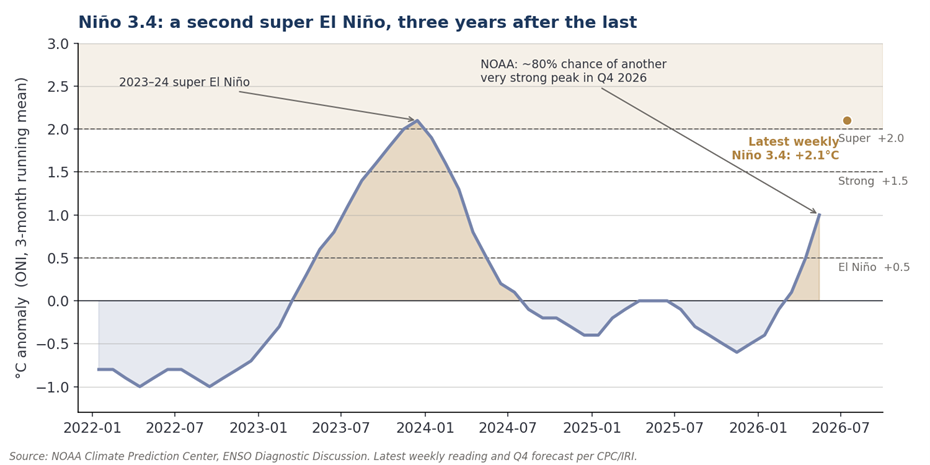
Figure 1. Niño 3.4 sea-surface temperature anomaly (ONI). Source: NOAA Climate Prediction Center.
| The drought signature of an El Niño, dryness across Southeast Asia, Australia, the Indian monsoon belt, and West Africa, overlaps almost precisely with the growing regions for many of the world’s soft commodities. Sugar, coffee, and wheat are grown in regions where rain is about to fail. The row crops that dominate headline agriculture, U.S. corn and soybeans, sit largely outside that footprint and, if anything, tend to see favourable Midwest summers in an El Niño year. This is the counterintuitive core of why a commodity portfolio should have a wide breadth of exposure. The weather shock everyone can name is benign for the crops that are typically on most investors’ radar, and acute for the ones they do not.
Sugar: why El Niño is a risk for white sugar but not raw Beginning with the effects on refined white sugar, futures markets are already moving to reflect the current landscape. Refined white sugar is up +15.0% year-to-date, while raw sugar is only up +1.8%. The premium of white over raw has widened by roughly thirteen percentage points this year. Over the past twenty years that refining premium has averaged roughly $98 per tonne; today it sits near $140, well above its long-run norm. |
Figure 2. London white sugar refining premium over NY No.11 raw, 20-year history. Source: Bloomberg, VIP.

The raw cane story is relatively straightforward as it relates to supply. El Niño drought in India, Thailand, and Australia cuts yields in the world’s major cane belts. India’s monsoon opened the season roughly 40% below normal in June, the weakest in over a decade, and has already pushed cane growers to delay planting; Thailand’s 2026/27 crop has been marked down 8%. But the widening white premium is telling a more specific story than just a supply story of less raw product. India and Thailand are the swing exporters of refined sugar, and they are precisely where the drought bites hardest. When India’s crop fails, New Delhi restricts exports, pulling the marginal tonne of exportable whites off the market. Brazil, which El Niño tends to spare, exports overwhelmingly raw. The weather shock tends to drain the white refined pool while leaving raw comparatively better supplied. During the 2023–24 super El Niño the same drought pulled India’s output lower and prompted an export ban, cut Thailand’s crop to a seventeen-year low, and pushed sugar to twelve-year highs.
The second driver is energy, which is where this connects back to escalating tensions in Hormuz. Refining raw sugar into white is energy-intensive, and higher gas and oil prices raise the cost of the refining process. The same geopolitical premium that lifts crude widens the refining margin that translates into the white premium. Higher oil prices also lift demand for Brazilian ethanol, pulling raw cane away from sugar and towards renewable fuel. The three channels of Asian drought, higher refining cost, and ethanol economics, are all pushing the spread higher. Viewpoint Diversified Commodities holds both the New York raw and the London white futures contracts, so the fund captures the widening premium, which is the point of having geographical diversification.
Coffee: one bean up, the other down
Coffee is another illustration of why breadth and esoteric commodity exposure matter for portfolio construction. Robusta coffee futures, the beans that are more frequently used for instant coffee, are up +9.1% year-to-date. Arabica, the beans that are generally used for brewed and specialty coffee and more widely followed as the liquid futures benchmark for coffee prices, are down −5.5%. The two beans have diverged by roughly fifteen percentage points, and the reason is a single weather pattern acting in opposite directions on two geographies.
Figure 3. Robusta vs. arabica coffee, year-to-date return. Source: Bloomberg, VIP.
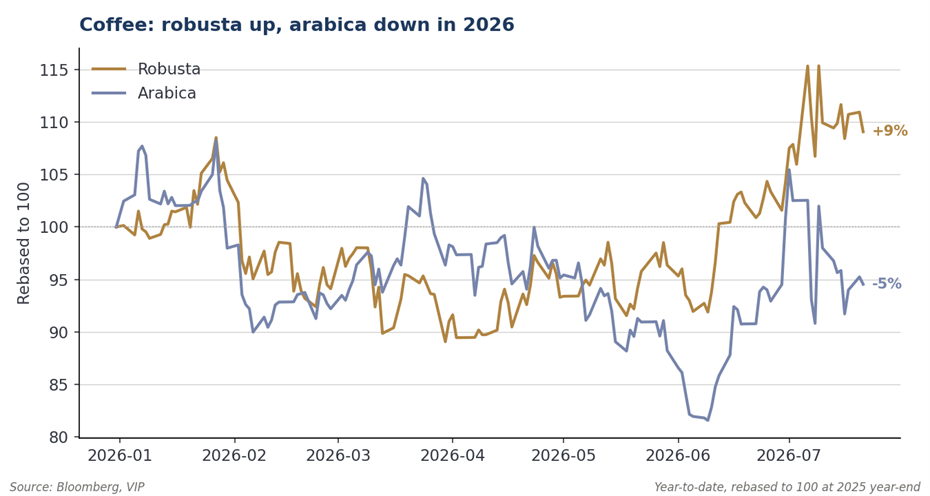
| Robusta is grown in the hot, low-altitude tropics, and concentrated in Vietnam, the world’s largest producer, with Indonesia close behind. Those are exactly the regions an El Niño dries out, and the drought is pushing robusta prices higher. Arabica, by contrast, is a highland crop concentrated in Brazil, where El Niño tends to bring the rain that supports a healthy cherry. Favourable Brazilian conditions have weighed on arabica even as drought lifts robusta. The last super El Niño displayed a similar pattern when Vietnam’s 2023–24 crop fell roughly a fifth and robusta ran to record highs. The 2023–24 example also shows how hard predicting weather is. Arabica went on to make its own record later, when Brazil turned from favourable growing conditions into drought. The robusta-over-arabica divergence holds only so long as Brazil stays wet, and those are the conditions worth watching.
This is what it looks like to capture events rather than to trade a flat commodity price, without understanding the unique supply and demand dynamics. A portfolio that owns “coffee” as a single line typically owns just the arabica futures, leaving you underexposed to the robusta variety. A portfolio built across the full opportunity set owns robusta and arabica as distinct instruments and is positioned for the divergence between the two, without needing to call the direction of coffee as a category. That is the design principle behind Viewpoint Diversified Commodities, and coffee is a great illustration of why the strategy emphasizes geographical diversification. Wheat: the convergence crop, with the weather leg still on the docket The wheat complex is where the two shocks, fertilizer and weather, can genuinely converge, and it is also where market pricing may still have to catch up. U.S. wheat markets have already rallied hard, driven by fertilizer disruptions tied to the Iran conflict and by a real drought across the U.S. southern plains, the hard red winter wheat belt, that has nothing to do with El Niño. Kansas hard red winter wheat is +37.9% year-to-date, Chicago soft red winter +28.6%, and French milling wheat +21.6%. So far, the U.S. contracts have led, and French milling wheat has lagged. Part of the rally is the fertilizer leg, a nitrogen-and-protein story that hard red winter wheat, the high-protein bread wheat most sensitive to fertilizer availability, expresses most directly. Wheat is one of the most nitrogen-hungry crops grown, and nitrogen drives not only yield but the protein content that defines milling quality. A fertilizer squeeze at planting concentrates its damage in exactly the high-protein tier the market prices off. The rest is weather that has already happened, with the USDA cutting its 2026 hard red winter production estimate by roughly a third from a year ago on drought, freeze, and disease across the plains. |
|

| The El Niño leg is different, and it is not yet in the price. The weather trade in wheat is Australia, a top-five exporter that El Niño reliably pushes toward drought. Australia ships white milling wheat into Asia and the Middle East, and when that supply fails, the displaced demand calls on the European and Black Sea complex on both quality and freight. French milling wheat is the liquid benchmark for that substitution. The same El Niño that dries out Australia tends to bring relief rain to the U.S. southern plains and to help the Argentine wheat belt. The weather pattern now developing could therefore ease the very U.S. drought that has powered the hard red winter rally, even as it deepens the Australian drought that supports milling wheat. The event that cools the leg that has led is the same event that fuels the leg that has lagged.
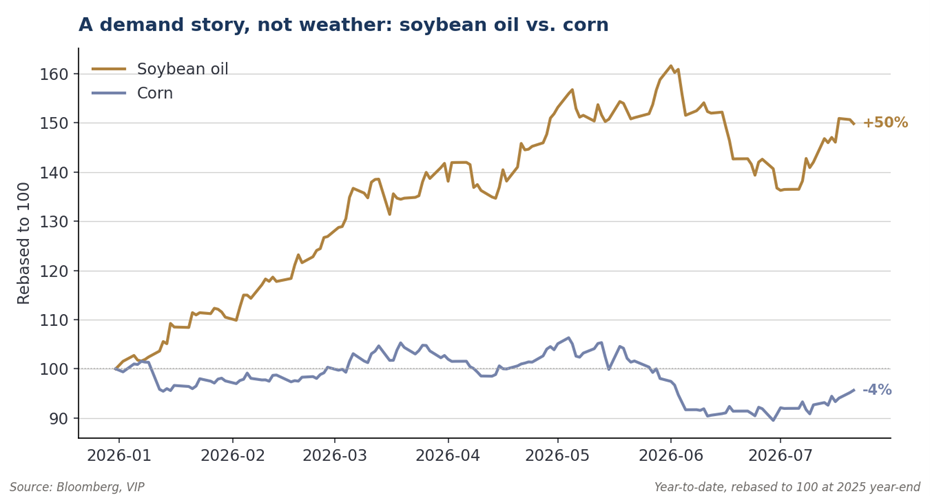
The market has priced the fertilizer leg and the U.S. drought, and it did so through U.S. wheat. It has not yet priced the El Niño leg, which favours the more esoteric French milling wheat that Viewpoint Diversified Commodities also holds, and Australia’s crop is not harvested until late this year. While the weather catalyst for Australia’s crop could be constructive for French milling wheat pricing, in the 2023–24 super El Niño when Australia’s crop fell 37%, global wheat prices still declined because Russia harvested a record crop and undercut everyone taking share in Australia’s own Asian markets. Being right on the Australian drought from a super El Niño was not the same as being right on the flat price across the complex. However, given that wheat prices are fungible on flat price, and absent a bumper crop in Russia, an Australian shortfall lifts the whole complex, and the milling-wheat position is a relative expression riding an absolute tailwind. Supply shock for some, supply boon for others While El Niño may have an impact on more esoteric commodities, it is unlikely to be a positive price factor for the more popular U.S. row crops. Corn is −4.4% year-to-date, and that is the textbook El Niño outcome, with market participants anticipating a favourable U.S. growing season that is comfortable for the crops that dominate the acreage debate. Soybeans are +10.7%, but that strength is a demand story rooted in crush and renewable diesel, not a weather one. Soybean oil, the renewable-diesel feedstock, is up nearly +50% year-to-date, far outpacing the bean itself. Figure 5. Soybean oil vs. corn, year-to-date return. Source: Bloomberg, VIP.
|
| And the picture in natural gas is regional. Since the Iran war began in late February, U.S. Henry Hub has fallen 16%, while Dutch and U.K. gas have risen 89% and 79%. The same shock that left America’s shale-supplied market oversupplied collided with a European market that is import-dependent and running its storage unusually low, around 52% of capacity against a five-year norm closer to 75%. Looking ahead, El Niño adds a further U.S.-specific downside tilting the Northern Hemisphere toward a milder winter and softer heating demand, a signal that is stronger and more reliable for the United States. The warmer northern tier reliably cuts heating load in the U.S. more so than in Europe, whose winters are driven more by the North Atlantic Oscillation than by the Pacific. A milder winter would weigh most on the oversupplied U.S. market and would be bearish for domestic prices. That regional split is why Viewpoint Diversified Commodities holds Dutch and U.K. natural gas alongside Henry Hub, so the gas exposure is diversified to different geopolitical and weather events. | |
|

Happy Investing!
Scott Smith
Chief Investment Officer
ABOUT THE AUTHOR

DISCLAIMER:
This blog and its contents are for informational purposes only. Information relating to investment approaches or individual investments should not be construed as advice or endorsement. Any views expressed in this blog were prepared based upon the information available at the time and are subject to change. All information is subject to possible correction. In no event shall Viewpoint Investment Partners Corporation be liable for any damages arising out of, or in any way connected with, the use or inability to use this blog appropriately.