
Executive Summary
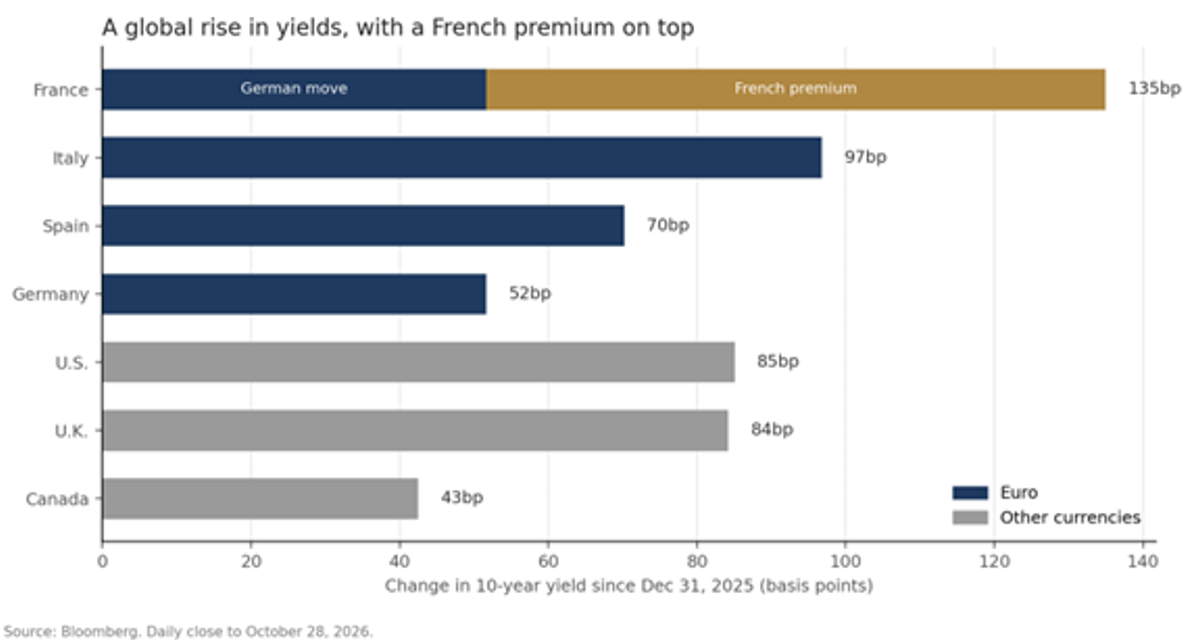
- The rise in bond yields this year is a global story, but France has become a flashpoint. Ten-year yields are up between 50 and 100 basis points in the U.S., the U.K., Germany, Italy and Spain. France's ten-year is up about 135 basis points, with yields now at their highest level since 2002.
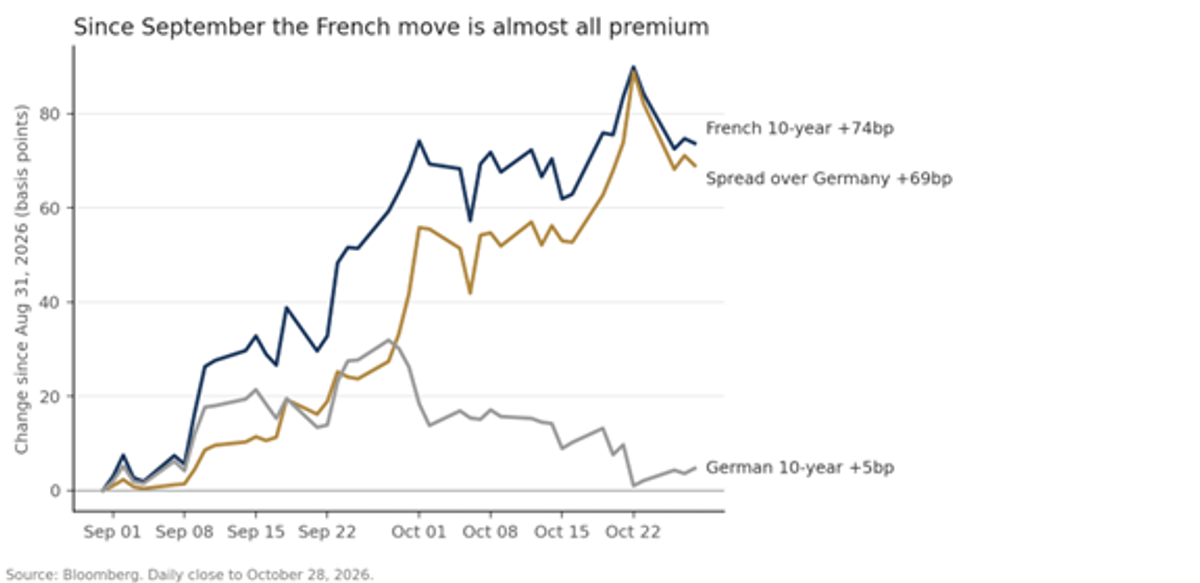
- Since September the move has been almost entirely a French risk premium. German yields are essentially unchanged since the end of August while the gap between French and German yields has widened to its widest since the euro crisis of the early 2010s.
- Path matters more than the level of debt. France now borrows at a higher rate than Italy despite carrying less debt and half the interest burden relative to tax revenue, because Italy's deficit, total debt, and political stability are moving in the right direction and France's are not.
- The budget is not what changed. The 2027 budget trims the deficit modestly and, by most accounts, came in slightly better than expected. What changed is the market's confidence that whatever government France elects in 2027 will be able to deliver the needed fiscal adjustment. With the political centre collapsing, a presidential runoff between the far right and the far left has become a real possibility, and the doubt now extends to whether the winner will have a working majority in parliament to govern with.
- The rise in French risk premium has forced Marine Le Pen to talk like a fiscal hawk, proposing a constitutional debt brake modelled after Germany. Whether that is a real plan or a campaign promise depends on the parliament the French people ultimately elect, along with the fact that the proposed deficit path of her budget does not yet meet her own rule.
- The cautionary tale has ramifications for other Western countries drifting to the wings away from the centre. The plumbing is different in the U.S. with the ability to print its own currency, so any political risk is seen through term premium as opposed to credit risk. The midterms look likely to deliver gridlock, which markets have historically welcomed. But the more important read for the midterms is if the Democrats win control of Congress, which candidates delivered the win and how does that shape their platform into 2028, with specific attention to the budget deficit.
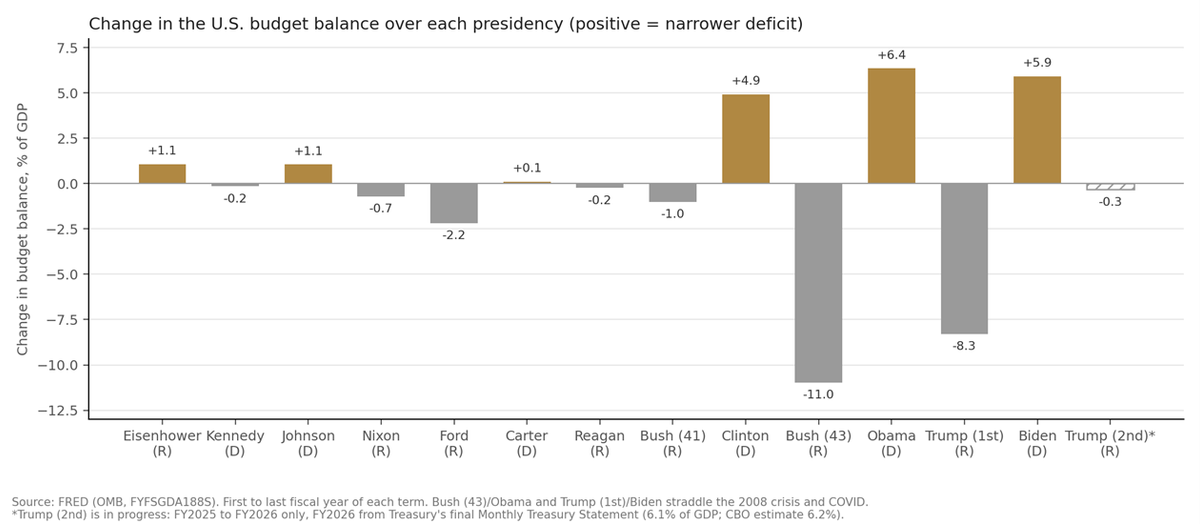
- Historically deficits narrow with a centrist administration checked by the other party. Since Eisenhower only one of seven Republican presidents has left office with a smaller deficit than he inherited, against five of six Democrats, though that record flatters the Democrats as noted below. The one clean consolidation came from a centrist (Clinton) working with a Republican Congress.
- We remain underweight international duration from a discretionary house view perspective. The modest duration we added in the belly of the U.S. curve, as discussed in our third quarter commentary, is a U.S.-only position, and we feel it is too early to go long French bonds until there is credible evidence that whoever governs France after 2027 is willing and able to follow an Italian-style consolidation.
In our third quarter commentary we noted that the spread between French and German government bonds had moved to its widest since the euro crisis in the early 2010s, and that Europe's long end was a sovereign-credit and fiscal story. In the weeks since, the French ten-year yields have risen further while cost-of-living protests are turning violent across the country. With elevated debt levels and already wide fiscal deficits, there isn’t much room for the French government to increase spending to appease protesters without making cuts in other places. Which means that the most likely outcome is some sort of painful consolidation where the incoming government is forced to choose what sacred cows in the budget might not be worth fighting for anymore. However, the path towards a functioning government is fraught with landmines and is effectively a supercharged extension of what played out in 2024 when Macron dissolved parliament and the election produced three coalition blocs that ultimately ended with widening fiscal deficits. What makes it worth a closer look is not just what it means for French bonds, but what it says about how bond markets price politics in precarious fiscal positions, which has ramifications for how to think about the U.S. midterms on November 3 and the path towards the next presidential election in 2028.
The French Premium
Rising yields have been a global phenomenon this year, a theme we covered in our recent note called Fighting the Tape. Ten-year yields are up close to a full percent in the U.S., the U.K. and Italy, and roughly half a percent in Germany and Canada (Figure 1), driven by strong nominal growth, an energy shock from the wars in the Middle East and Eastern Europe that has kept inflation sticky, increased defence spending as a result of the wars, supply chain reshoring, and the AI build-out flooding the market with long-dated corporate debt that competes with governments for the same pool of investors. France has been swept up in all of that, but political shockwaves have compounded the issue of rising global bond yields. Of the roughly 135 basis points the French ten-year has risen this year, about 50 is move every other developed market has seen, and the remaining 85 or so is the risk premium that investors are demanding to hold French debt.
FIGURE 1: Change in 10-year government bond yields since December 31, 2025 (basis points)
(Source: Bloomberg)
The character of the move changed in September. Through the summer France mostly rode the global wave, but since then German yields have stabilized while French yields have kept climbing, which means the recent damage has been a French risk premium (Figure 2). This leaves the gap between French and German yields at levels not seen since the euro crisis, while the cost of insuring French government debt against default (five-year credit default swaps) has roughly tripled since the summer. At around 100 basis points it remains well short of the 2011 peak, but the move itself illustrates that investors are paying for protection against a credit outcome, not simply absorbing a heavy supply of bonds through a higher term premium.
FIGURE 2: Change in the French 10-year yield since August 31, 2026, and how much came from German yields versus the French spread (basis points)
(Source: Bloomberg)
France Is Not Italy, and the Path Matters
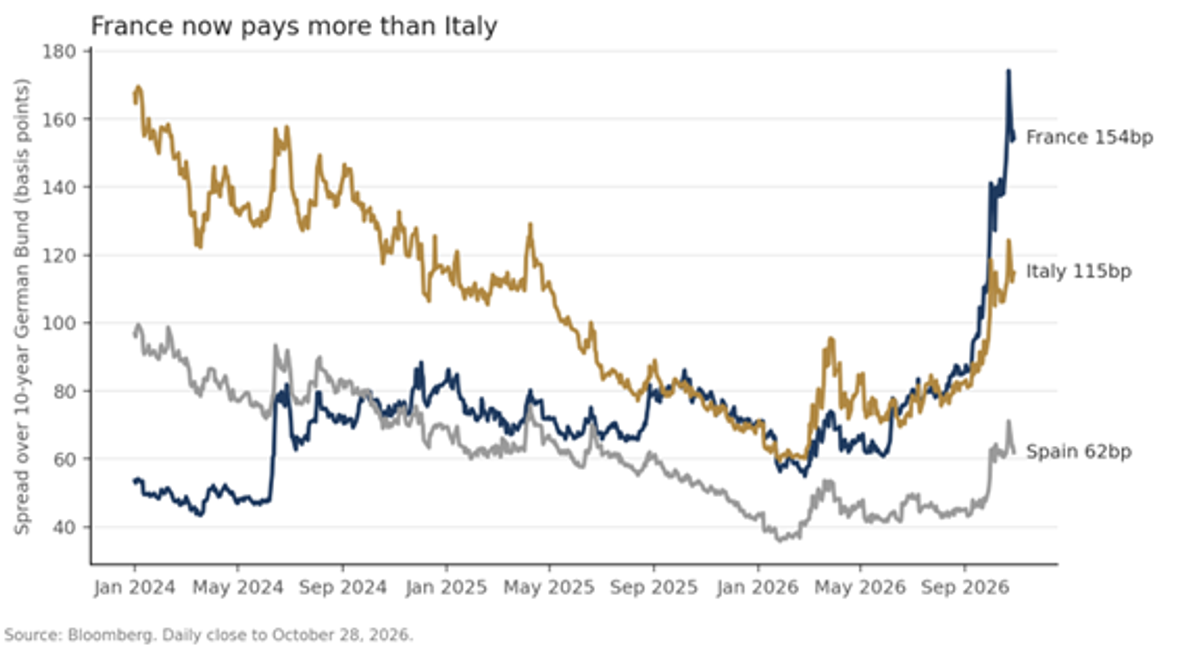
The most striking chart in Europe right now is France borrowing at a higher rate than Italy (Figure 3). For most of the euro's history Italy has been the problem child, and on total debt to GDP it still looks worse at 137% relative to France's at 116% and is spending about 8% of its revenue on interest against France's 4%. However, France now pays roughly 40 basis points more than Italy to borrow for ten years, a situation many would have thought unthinkable at the start of the 2020s.
FIGURE 3: 10-year government bond yield spreads over Germany (basis points)
(Source: Bloomberg)
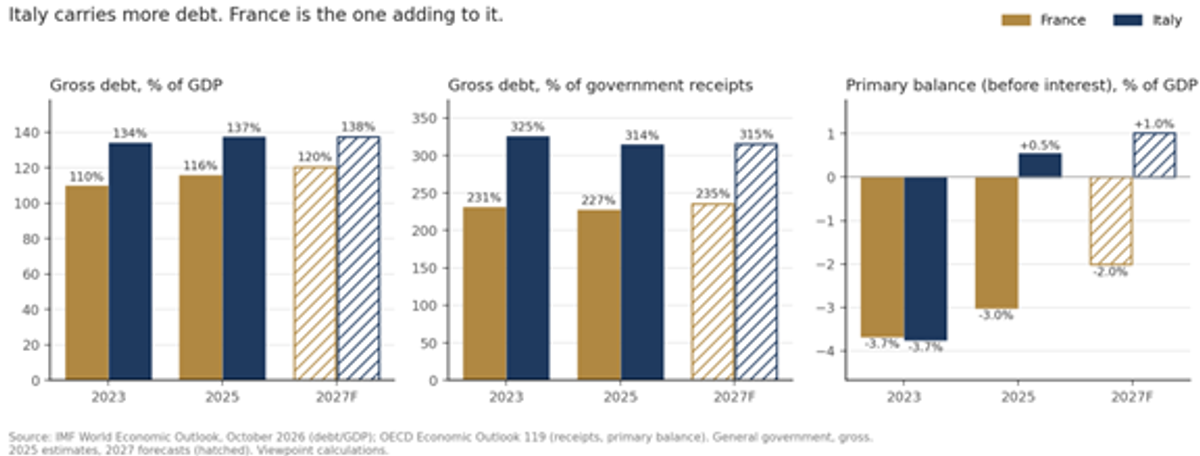
My view is that bond markets care far more about the direction of travel than any specific level. Italy has taken its deficit from over 7% of GDP in 2023 to about 3% today, is running a surplus before interest payments (Figure 4), and has a debt ratio that is expected to peak this year and then start falling, all under a government that has been stable since 2022. Italy has had 68 governments since it abolished its monarchy after WWII and in September Meloni became the longest serving of them, while France on the other hand has gone through four prime ministers since the start of 2024. On the fiscal side, France is also going the other way, with a deficit that rose this year to about 5.4% of GDP, a debt ratio climbing toward 120% with no peak in sight, and no parliamentary majority since 2024. The simple arithmetic of debt is that the debt ratio can be stabilized only when the budget surplus before interest covers the gap between the interest rate on the debt and the economy's growth rate. Italy's primary surplus is sufficient to clear that bar, while France runs a deficit before interest of roughly 3% of GDP, so its debt rises every year. France’s debt arithmetic also continues to worsen as old low-coupon bonds roll into a market where the ten-year yields are now roughly two percent more than nominal GDP. Bond vigilantes may forgive a high debt load that is falling, but they are far less forgiving of a moderate one that is rising with no explicit political mandate to arrest it.
FIGURE 4: France and Italy, general government gross debt as a share of GDP and of government receipts, and primary balance as a share of GDP, 2023 and 2025
(Source: IMF World Economic Outlook, October 2026; OECD Economic Outlook 119; Viewpoint calculations)
Not a Budget Story
The problem bond vigilantes are closely monitoring isn’t the current budget. The government's 2027 plan cuts the deficit from 5.4% to 5.0% of GDP, along with providing €4 billion in school-renovation loans to calm the student protest. But the modest cut to the budget deficit does little to change the trajectory, with Shahin Vallée, a former adviser to Emmanuel Macron, told Bloomberg's Odd Lots podcast that investors are worried "not because there is anything new about fiscal policy," noting the budget came in a touch better than expected, and that "what has changed in the last few weeks is the perception of the political risk."
That political risk has two intertwined parts, both of which just stem from the overarching collapse of the centre. For most of the past two years the market assumed the 2027 presidential runoff would pit Marine Le Pen against a centrist who would likely win, but since the summer the centrist candidates have slipped in the first-round polling and now trail Le Pen in head-to-head matchups, and betting markets are now leaning towards Le Pen versus Jean-Luc Mélenchon runoff, both of which run on protectionist, big-government programs from opposite ends of the political spectrum. Vallée described Macron as France's version of Matteo Renzi, the last centrist trying to hold the middle together. The second worry is that a French presidential election is followed by a legislative one, and while it looks like Le Pen is the favourite to win the presidency, she may not be able to win a working majority in the National Assembly, particularly against a strong far-left bloc. The market had been giving France the benefit of the doubt that by 2027 it would have a president and a parliament able to agree on a credible adjustment, and the markets are adjusting to the fact that might have been an overly optimistic view.
Can Anyone Fix It?
The French situation may not resolve until the elections next spring, and the ECB backstop to contain borrowing costs is unlikely to be available in the interim. Since the euro crisis the ECB has had tools to cap a member's borrowing costs, but they come with conditions, chiefly that the country be on a credible path back to the European fiscal rules, and France has been under the EU's excessive deficit procedure since 2024. That makes it something of a catch-22, since a country able to commit to consolidation would not need the backstop. German politics add a further obstacle, as an unconditional rescue of France is about the fastest way to rally support for the far-right AfD.
The French public, at least in principle, appears ready for debt consolidation. A record 84% told the pollster Elabe this summer that reducing the debt is urgent, yet large majorities rejected the main healthcare savings, which is the familiar gap between wanting a consolidation and voting for one. Pensions are where the meat of the deficit issue is, with France spending close to 14% of GDP on them, about a quarter of all public spending. Pension reform by raising the retirement age from 62 to 64 was forced through parliament without a vote in 2023 and ended up poisoning the rest of Macron’s term. Last December parliament suspended even that until after the election, which was needed in a gridlocked parliament to pass the budget. The largest line in the French budget has, in effect, been taken off the table until a new government is in place. Tackling pension reform and the budget deficit gap will take a government with a mandate, something a centrist has not been able to do.
Which brings us to Le Pen, who despite being a populist in favour of larger government entitlements, has been working hard to reassure the bond market now that it looks more likely that the presidency is within reach. Recently she has proposed writing a "golden rule" modelled after Germany into the constitution by referendum, requiring the deficit to stay below the level that stabilizes debt until debt falls under 60% of GDP, with exceptions for a crisis requiring a three-fifths vote of both houses of parliament. With debt at 120% of GDP and nominal growth near 3%, the rule implies a deficit of about 3% to 3.5%, well below the 5% in the current budget. The practical hurdles are significant, as amending the French constitution requires both the National Assembly and the Senate to pass the same text before a referendum, so Le Pen will need a working majority which the market is currently doubting. Her own deficit path also stays above the level her rule would allow through roughly the end of the decade, which suggests either a long phase-in or a budget that will need to be cut further.
The outcome that should matter most for the French bond market is not whether Le Pen reaches the second round, but who joins her in the run-off. Prediction markets lean to Jean-Luc Mélenchon taking the second spot over Édouard Philippe, Macron's first prime minister and the strongest of the centre-right candidates, but only narrowly. A Le Pen versus Philippe runoff gives investors a credible consolidation path and should help to alleviate some of the political risk premium that has built up in bond yields. A Le Pen versus Mélenchon runoff on the other hand leaves voters choosing between two platforms that have promised more entitlements and more autonomy from Brussels. Le Pen’s debt brake is the only fiscal anchor being proposed, but her budget would likely have to be some combination of pension reform and/or wealth tax to get the deficit within those strict limits, and the combination will likely contain elements that both controlling blocs of parliament don’t like, which may actually be palatable so that no single party is on the hook for the reforms that are required.
The Read-Across to Washington
The U.S. is not France, but some of the same forces are at work, and the midterms next week will provide more information on the progression of these themes. The political centre is thinning in both parties, with progressive candidates winning a string of high-profile Democratic primaries this year, including a Senate nomination in Michigan, and the Republican Party firmly in the hands of its populist wing. Neither wing is campaigning on narrowing the deficit. The Democratic agenda of restoring healthcare subsidies, reversing Medicaid cuts and repealing tariffs, would add close to 1% of GDP a year to the deficit. Outside of horse trading around a funding deal for the debt ceiling, the presidential veto would come into play, so the likely path is gridlock until the 2028 presidential election, despite the intent of the Democratic platform.
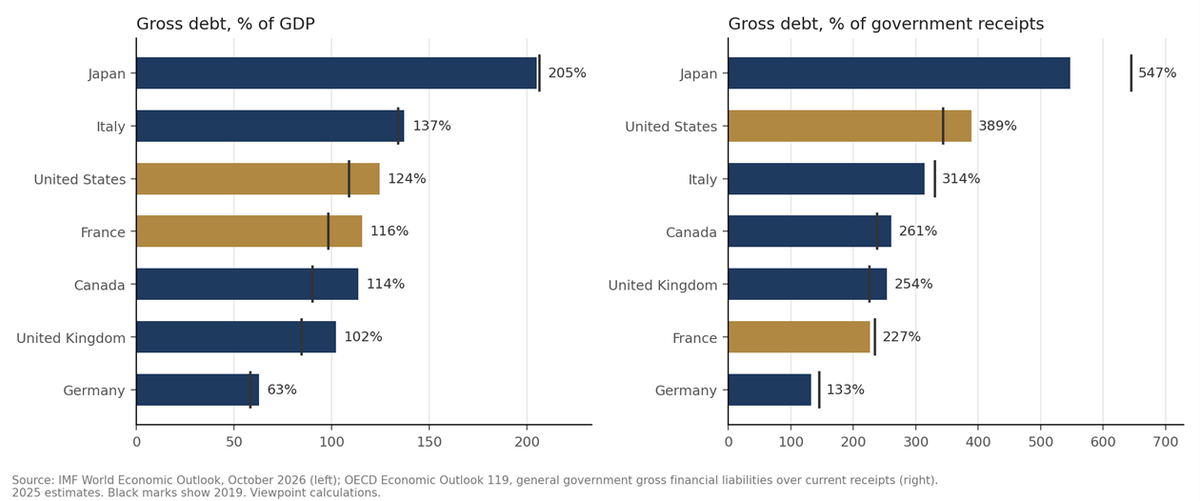
The fiscal starting point is also worse in the U.S. than it looks. Measured against the size of its economy, U.S. debt sits in the middle of the G7, not far from France. Measured against what the government actually collects in taxes, it is second only to Japan and has risen more than any other G7 country's since 2019, while France's has edged down (Figure 5). Close to 15% of U.S. government revenue now goes to interest, against a little over 4% in France. The U.S. does not have a spending problem so much as a revenue gap, collecting roughly a third of GDP in taxes against about half in France, which as we see it makes higher taxes a likely part of any eventual fix, which is one of the reasons we have viewed tariffs as likely being a structural part of U.S. trade policy given they act similar to a VAT.
FIGURE 5: G7 general government gross debt as a share of GDP and as a share of government receipts, 2025 (black marks show 2019)
(Source: IMF World Economic Outlook, October 2026; OECD Economic Outlook 119; Viewpoint calculations)
The other major difference is that France borrows in a currency it does not control, so stresses show up as a credit spread over German paper. The U.S. borrows in a currency its own central bank issues, so a political risk premium would look like a higher term premium (the extra yield investors demand for tying money up for longer), a weaker dollar, and bonds that stop hedging equities, which is the pressure valve we described in Fighting the Tape.
On the midterms themselves, prediction markets have the Democrats as heavy favourites to win the House and modest favourites in the Senate, and if that plays out, gridlock should be a positive for financial markets. With a Republican in the White House until 2029, a Democratic Congress cannot codify new spending, and a frozen policy agenda reduces uncertainty, which tends to explain why the S&P 500 has moved higher in the twelve months following every midterm election since the 1950s. It’s unlikely that a new Congress will arrive with a mandate for austerity, until the pain shows up in interest rates and ultimately housing affordability.
The more important question is how the Democrats win if they take both chambers. A majority built on centrist candidates flipping seats in Republican-leaning states is a very different caucus from one in which progressive candidates in safe Democratic seats outrun expectations, and the composition of that majority will shape the 2028 nominee and platform, and with them the deficit. Just as it may fall to a populist in France to straighten out the budget, the U.S. question is is not so much which party ends up holding the majority, but what wing of the party got them the majority. Since Eisenhower, only one of seven Republican presidents has left office with a smaller deficit than he inherited, against five of six Democrats, and the first year of President Trump's second term has seen the deficit widen slightly (Figure 6). The caveat to the Democrats' record is that Obama and Biden both began at crisis-driven peaks, but the one clean, large consolidation of the modern era came from Clinton, a centrist Democrat working with a Republican Congress. The common thread through most of the deficit deals of the past forty years is a president willing to deal, checked by the other party in Congress, so both sides share the blame for the unpopular parts.
FIGURE 6: Change in the U.S. federal budget balance from the first to last fiscal year of each presidency (% of GDP)
(Source: FRED, OMB, U.S. Treasury)
What It Means for Portfolios
Pooled funds. Viewpoint Investment Partners' pooled funds allocate capital through a rules-based, systematic framework. The views in this letter do not change how the funds are positioned.
Separately managed accounts. For Viewpoint Private Wealth clients in separately managed accounts, our portfolio managers apply these house views at their discretion when they make allocation decisions. Our house view is that we continue to be underweight international duration, in contrast to the modest duration we added in the belly of the U.S. curve that we discussed in our third quarter commentary. The French political risk premium has been widest at the long end of the curve, which also fits with our broader steepener view. We will be watching the spread between French and German bonds for signs that Le Pen's debt brake can be a credible solution, and how the presidential election runoff could foreshadow cooperation towards debt consolidation following the next legislative election. If Philippe makes it to the runoff, then that could be a sign of optimism for deficit reform, but it is too early to be confident about going long French bonds without credible evidence of an Italian-style consolidation.
In a multipolar world where the political centre is under pressure across developed democracies, the bond market is reminding us that it prices politics as much as it prices budgets, and that the path a country is on matters more than where it starts.
Happy investing!
Scott Smith
Chief Investment Officer
This commentary is published by Viewpoint Investment Partners Corporation (VIPCo) and Viewpoint Private Wealth (VPW) for their clients, investors in VIPCo's pooled funds, and prospective investors. It is for general information only. It is not investment, tax or legal advice, and it does not consider the objectives or circumstances of any individual reader. The views expressed are those of the authors as of October 2026 and may change without notice.
Separately managed accounts. VPW portfolio managers apply these house views at their discretion in separately managed accounts. The positioning described in this letter refers to those accounts. It varies by account, based on each client's objectives, risk tolerance, liquidity needs, tax circumstances and investment restrictions. A suitability assessment is completed before an account is opened.
Pooled funds. VIPCo's pooled funds allocate capital through a rules-based, systematic process. The views and positioning in this letter do not determine the funds' holdings. This letter is not an offer or solicitation to buy securities of any fund. Fund securities are offered only through the applicable prospectus or offering memorandum, and some funds are available only to investors who qualify under a prospectus exemption, such as accredited investors. Commissions, trailing commissions, management fees and expenses all may be associated with mutual fund investments. Please read the prospectus before investing. Mutual funds are not guaranteed, their values change frequently and past performance may not be repeated.
Statements about future events are opinions, not guarantees. Past performance and historical market patterns do not guarantee future results. All investments involve risk, including possible loss of capital. Third-party information is believed to be reliable but has not been independently verified and is not guaranteed. VIPCo, VPW, their affiliates, their clients and the funds they manage may hold positions in the securities or sectors discussed.