
Executive Summary
- The long end of the Treasury curve continues to fall out of favour with investors. The 30-year is now well above 5%, touching a 19-year high in mid-August. The 10-year has not been immune to selling pressure, with yields up nearly half a percentage point this year.
- Despite headlines being centred on U.S. federal debt crossing $40 trillion last week, three major forces are putting upward pressure on rates. The war in Iran has kept oil and refined product prices elevated, which translate into higher short-term inflation, but there are broader macro worries about increased defence spending (no fiscal restraint in sight) and the U.S. security blanket for allies in the Middle East. Nominal U.S. GDP growth has been strong in 2026, which by itself is negative for bond prices, but it also dovetails into an AI infrastructure build-out that is flooding the market with long-dated corporate paper that competes directly with demand for the U.S. long bond.
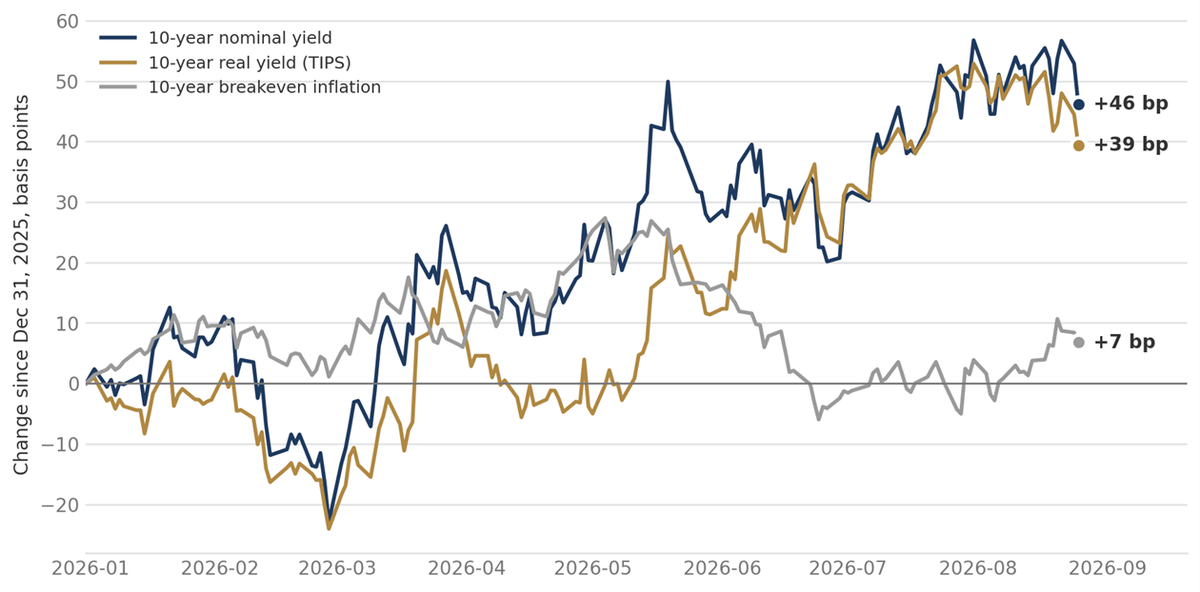
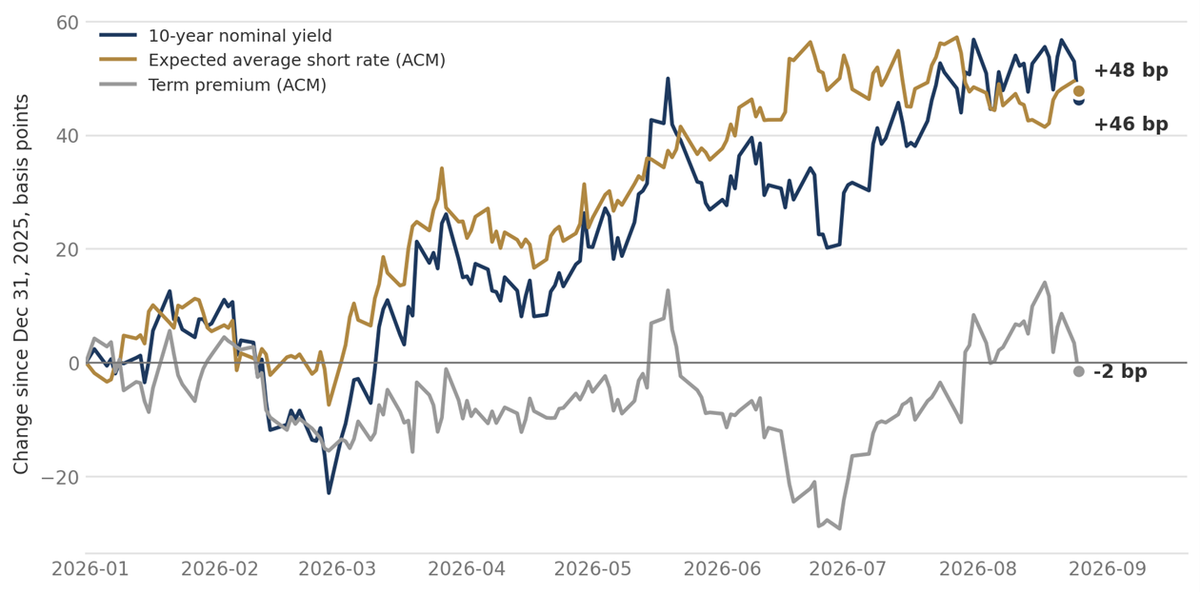
- The rise is actually a real-rate story, not just an inflation story. Of the roughly 45-basis-point increase in the 10-year this year, 40 basis points came from real yields and less than 10 from inflation expectations (breakevens rising). On a net basis, nearly all of the move reflects repriced growth and policy expectations, but the character of the selloff changed at the end of June. Since then the New York Fed's term premium estimate has risen close to 30 basis points while rate expectations have gone sideways, meaning the leg that carried the 30-year to a 19-year high is almost entirely investors demanding more compensation for bearing duration.
- Treasury Secretary Scott Bessent is fighting the tape and trying to keep a lid on yields heading into the midterms. In the span of a month the Treasury has intervened in the yen market by selling euros to buy yen alongside Japan's Ministry of Finance, doubled the long-end buyback program, floated funding further buybacks out of a nearly $1 trillion Treasury General Account, and lobbied the Fed to expand its FIMA repo facility so foreign central banks can borrow against their Treasuries if they need to raise cash rather than having to sell their Treasuries outright.
- Bessent built part of his public profile criticizing Janet Yellen for skewing issuance toward bills, calling it stealth quantitative easing designed to cap long-term yields. However, looking at the deficit train (as well as other issues like Iran) barrelling down the track, he is now running the same playbook at a considerably larger scale. The irony is that each tool shortens the maturity profile of U.S. debt, raising rollover risk and quietly increasing the pressure on the Fed to keep short-term rates low.
- This sequence of events from Bessent could ultimately handcuff Fed Chair Warsh. He has argued that higher long-term rates can do some of the Fed's tightening for it, yet equities have set records since the July meeting and the only tightening in the system that was happening was at the long end. There is still the potential that AI productivity (and a resolution in Iran) could buy the Fed some more time, but without the long-end to tighten financial conditions, hiking short-term rates becomes more likely. Warsh's first Jackson Hole speech as chair comes Friday, and it will be interesting given he does not like forward guidance.
- As we've mentioned before, the pressure valve is the currency. If yields are managed and deficits are not, the dollar becomes the natural release, and the debasement trade from earlier this year comes back into view.
- The macro backdrop remains bond negative, though not an economic meltdown. At these levels there are legitimate reasons to own Treasuries as portfolio hedges, but we wouldn't get bullish on bonds until the market forces the administration to tackle the deficit. Our higher-conviction expressions remain long commodities and short the U.S. dollar.
In February of last year I wrote that Scott Bessent had calmed the Treasury market by leaving Janet Yellen's bond issuance plans intact, noting with irony that this was exactly what he criticized his predecessor for, running "stealth" quantitative easing by tilting issuance toward short-dated bills to keep a ceiling on long-term yields as the market would therefore have less duration to absorb. Eighteen months later there are fresh concerns in the long-dated Treasury market, with the 30-year spending its longest stretch above 5% since 2007, prompting Treasury Secretary Bessent to look for new ways to keep a lid on rising yields, which ultimately impacts corporate borrowing costs and mortgage rates.
Why the Long End is Getting Squirrelly
Before we get into what Bessent's fiddling in the Treasury market might mean for asset class outlooks and positioning, let's first start with why there is suddenly such a focus on yields.
The first is the war in Iran, now in its sixth month and showing little in the way of coming to a neat and tidy solution where the Strait of Hormuz looks as it did before the war. Even with the movement away from kinetic action to economic sanctions, Brent still sits comfortably higher than it was pre-war, and refined product spreads are still pushing higher (what consumers actually pay for) as refining capacity remains scarce. The war in Iran was originally undertaken with an optimistic timetable, and the absence of a quick end has now been converted into a policy mistake with a rising fiscal tab. The record $1.5 trillion defence budget request layers onto a deficit that was already precarious in an economy running hot, precisely the combination that is spooking long-bond investors. The Dallas Fed's work on the conflict estimates that a quarter-long closure of Hormuz adds around 0.6 percentage points to headline inflation. Therefore, the war translates into a yield story through both the deficit channel and the inflation channel at once, but I would also argue the policy mistake raises questions about the long-term effectiveness of the U.S. security umbrella and the status of the petro-dollar.
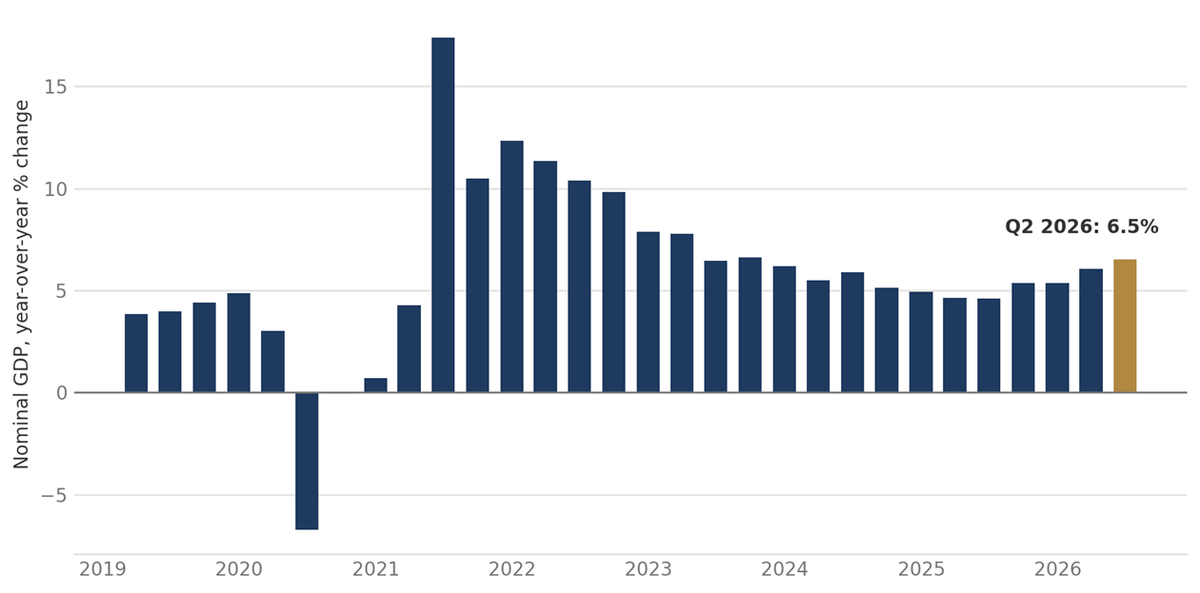
The second force that is putting upward pressure on yields is that the U.S. economy is strong. Nominal GDP grew 6.5% year-over-year in the second quarter (Figure 1) and while real GDP looked soft in Q2 at 1.5%, much of that war-related disruption, the Atlanta Fed's GDPNow estimate of real growth for the third quarter is at 4.6% as of its latest update, powered by strong private investment. An economy generating mid-6% nominal growth is one where you would expect to see rising yields because of strong economic growth. With nominal growth of 6.5% running well above a 4.6% nominal 10-year, the economy still outgrows the government's borrowing cost, which is what keeps the administration's grow-out-of-the-debt strategy alive on paper, but the distance between 6.5% nominal and 1.5% real tells you how much of that growing-out is inflation doing the work, which is the crux of the dollar debasement trade coming back into focus.
Figure 1: U.S. nominal GDP, year-over-year % change, quarterly (2019–2026)
(Source: Bloomberg)
The third force for higher yields is one of the reasons for the strong U.S. economic growth, and that is the AI build-out. Hyperscalers and their suppliers are financing data centres with long-dated investment-grade paper, and the tech complex has borrowed roughly $200 billion in 2026, about five times last year's pace. According to Barclays, some 13% of investment-grade debt sold in 2025 carried maturities beyond ten years, but in 2026 that figure is running at 20%, which means investors will have to absorb an extra $190 billion of long-dated corporate debt this year, a number equivalent to nearly 70% of the $276 billion in annual 30-year Treasury issuance. What this means is that, in addition to hyperscalers burning through their free cash flow, highly rated corporates are, in effect, competing with the Treasury for the same pool of duration capital. This crowding-out effect is also putting upward pressure on yields, with Bank of America estimating the issuance surge has added roughly 0.3 percentage points to the 10-year this year.
Decoding the Yield Uplift
To shore up our qualitative assessment of why yields are backing up, we can also decompose what factors have contributed to rising yields.Of the 46 basis points the 10-year has risen this year, how much is due to economic growth, how much is due to higher inflation concerns, and how much reflects investors demanding more compensation for bearing duration risk?
Looking at the inflation-linked bond market, 10-year real yields have also risen 39 basis points this year, which tells us that little of the nominal rise in yields is due to inflation expectations (Figure 2). As of right now, the market is not pricing an inflation spiral in the long-term, it has repriced the real return required to hold U.S. government paper. The New York Fed's ACM model then lets us split the move a second way, into the expected path of short rates and the term premium. Across the full year the expected-rate component has done nearly all the work, rising 48 basis points against a term premium that is actually down a touch on a net basis, which aligns with a 2-year yield up more than 70 basis points as markets priced a hawkish Fed and a hot economy. Put the two decompositions together and effectively all of this year's net real-yield rise is repriced growth, not duration compensation.
Figure 2: Change in 10-year nominal yield, real yield, and breakeven inflation, basis points, year-to-date 2026, data through August 25
(Source: Bloomberg)
The path of the term premium is the interesting component here, bearing more fruit than just looking at the net numbers. The term premium actually fell through the first half of the year, but has surged close to 30 basis points since the end of June, while rate expectations over the same stretch have gone sideways (Figure 3). In other words, the summer leg of the selloff that pushed the 30-year to a 19-year high and triggered the Treasury policy response of yen intervention and Treasury buybacks is almost entirely term premium. For level context as opposed to rate of change, the ACM premium averaged negative from 2016 through 2024 and has been solidly positive since 2025. At 0.74% it is not extreme against that new regime, but the speed of the June-to-August move is what has likely caught Bessent's attention. The growth repricing is not cause for concern, but term premium is exactly the component that responds to supply and credibility, and why tilting against term premium with intervention is unlikely to work in the long-term. However, if Bessent can get away with intervening to cap absolute yield levels in the short-term, he might be able to buy more time until the Iran conflict has concluded.
Figure 3: ACM decomposition of the change in the 10-year yield into expected average short rate and term premium, basis points, year-to-date 2026, data through August 25
(Source: Bloomberg, Federal Reserve Bank of New York)
Yen, Buybacks, and a Trillion-Dollar War Chest (kind of)
As a result of trying to keep a lid on long-term yields, we've seen three policy responses from the Treasury, each a response to the rising term premium.
The first came at the end of July, when Japan's Ministry of Finance (MoF) intervened to arrest a yen that had fallen to a roughly 40-year low, spending an estimated $53 billion in a single day. Not only did the MoF intervene in currency markets to prop up the weakening yen, but the New York Fed, acting for the Treasury, sold euros from U.S. reserves to buy yen, the first U.S. intervention in support of the Japanese currency since 2011. The choice of euros as the funding leg by Bessent avoided undercutting the administration's strong-dollar rhetoric, and the additional firepower saved the MoF from having to liquidate its U.S. bond portfolio to fund the defence of its own currency. Bessent has since pushed the point further, arguing publicly that the Fed should expand its FIMA repo facility so that foreign central banks can borrow dollars against their Treasury collateral rather than sell it. Whatever the merits, that decision belongs to the FOMC, and a Treasury Secretary lobbying the central bank to reshape its balance sheet facilities for debt-management objectives would seemingly blur the line of Fed independence, and it is not the only Treasury policy action that will have implications for Warsh at the Fed.
The second policy response came last week when the Treasury doubled its long-end buyback operations from a $2 billion maximum per operation to at least $4 billion in the 10-to-30-year buckets. The program was introduced in May 2024 as a liquidity-support tool, but in our view, the recent changes suggest it is increasingly being used as a yield-management tool. While the announcement helped initially ease yields, the relief it bought was short-lived and yields were back to previous levels within two sessions. The risk is that markets conclude the meddling exists because the fundamentals cannot bear scrutiny, the same inference they drew after Liberation Day, and once that inference takes hold, every intervention buys less than the one before it.
The third policy action was earlier this week when senior Treasury officials floated funding enlarged buybacks directly out of the Treasury General Account (TGA), which currently holds nearly $1 trillion. The Treasury's long-standing cash balance policy is to hold roughly one week of outflows in the TGA, subject to a floor of about $150 billion, a buffer designed to keep the government paying its bills through a temporary loss of market access or disruption. Using that cash to retire long bonds today, and refilling the account later with bill issuance, amounts to a maturity swap for the national balance sheet. This is similar to when the Fed was expanding its balance sheet through quantitative easing, buying bonds from banks and crediting their reserve accounts with cash, effectively a maturity swap, and why the Treasury buyback program is sometimes referred to as "stealth" quantitative easing.
From a number’s perspective, the Treasury's own August refunding assumptions have the account at $950 billion at the end of September and $850 billion by year-end, so roughly $100 billion could be redirected into buybacks instead of issuing fewer bills along this glide-path. $100 billion is two and a half times the current quarter's entire $38 billion liquidity-support program, so it could be a decent chunk larger than what is currently scheduled.
However, the formulaic approach where the cash buffer is sized to one week of outflows ends up growing as near-term obligations grow, and if the debt stock continues to migrate into bills that mature every few weeks, the TGA would need to grow along with it. Bank of America estimates that if coupon sizes stay where they are, bills will approach 25% of outstanding debt by fiscal 2027, the highest share since 2004 outside of crisis episodes. With the Treasury potentially increasing the magnitude of its maturity swap, not only does the TGA balance grow (depending on what coupons are getting retired) but it also means the government becomes more exposed to rising short-term rates. It also creates another avenue for Fed independence creep, with the administration increasing its bets (and interest expense) on lower short-term rates. This is arguably the biggest pressure point on the newly appointed Fed Chair, which becomes even more challenging with his disregard for forward guidance.
Warsh's Bind
The new Fed chair Warsh, who took the chair in May after a very divided confirmation vote, came in with a promise of getting inflation durably under control, shrinking the Fed's footprint, and abandoning forward-guidance. Warsh's case for less forward guidance is that markets provide a signal about the economy that policymakers can learn from. In Warsh's words, he wants investors to be the ball rather than watching the Fed's. From his perspective, and correctly, elevated long-term rates have already been tightening financial conditions on the Fed's behalf, doing some of the Fed's work without any change in the benchmark rate. However, the flip side of this is that the Fed controls the short-term rate and expectations of how the short-term rate will evolve over time, so de facto they are, and will always, be the ball. You could make the argument that the July Fed meeting is what really kicked off the increase in the 10-year term premium, as investors are still unsure how the Fed would credibly tackle inflation given there is no guidance as to whether that would be done through higher short-term interest rates, a smaller Fed balance sheet, or market forces through a steepening yield curve.
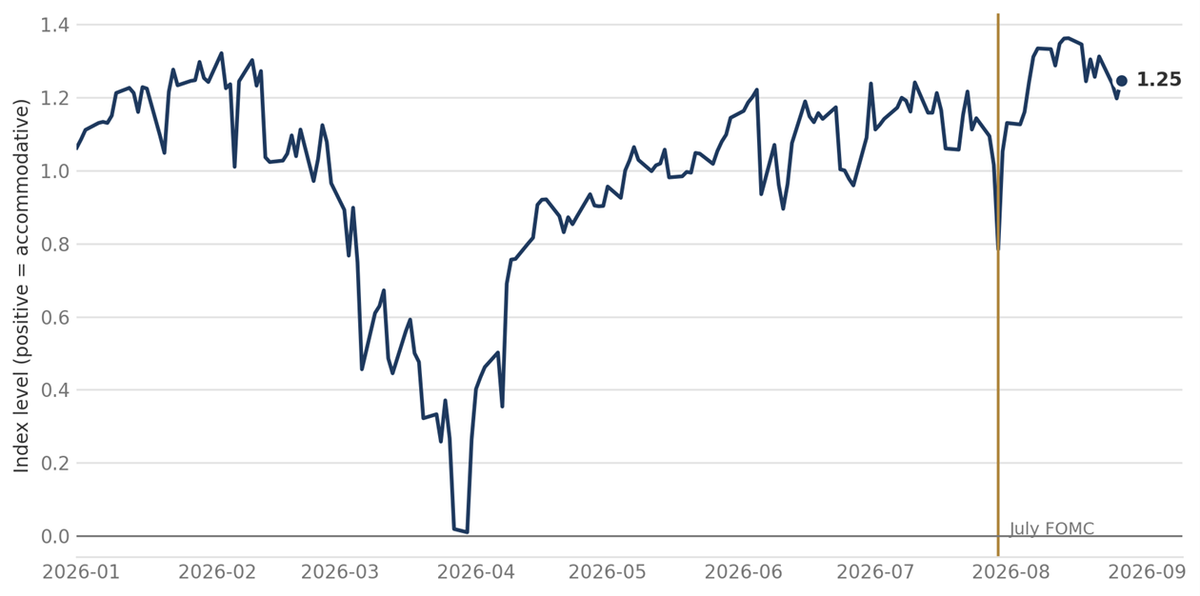
The problem is that the Treasury is now directly in conflict with how Warsh has communicated his policy goals. The market signal isn't really a signal if Bessent is buying back bonds to pull long yields lower, as the information content of the long end then degrades as a result. With the long end artificially suppressed in the short-term, the market tightening does not transmit through the bond market, and the economy continues to run hot. And even with the long end of the curve rising, the Bloomberg U.S. Financial Conditions Index has continued to loosen after the July Fed meeting and currently sits around its most accommodative readings of the year (Figure 4). If the long end continues to be managed, Fed policymakers could then be left with utilizing the short-term rate as a way to tighten policy, at the same time the Treasury's bill-heavy funding model depends on the policy rate staying low. Macquarie strategists Thierry Wizman and Gareth Berry have argued that the desire to finance the deficit cheaply could see the Fed co-opted into a financial-stability mandate, up to and including a return to QE. This could be a tough situation for Warsh, who has built his reputation criticizing the size of the Fed's balance sheet.
Figure 4: Bloomberg U.S. Financial Conditions Index, 2026 year-to-date, positive readings indicate accommodative conditions
(Source: Bloomberg)
All of this culminates in what should be an interesting Friday in Wyoming. Warsh delivers his first Jackson Hole address as chair at the annual symposium, with markets currently pricing in roughly one-in-three odds of a September hike. I don't anticipate much in the way of pre-commitment to a path without violating his own framework, yet silence could be read as tolerance of both a hot economy and the Treasury's long-end campaign. My expectation is that he uses the speech to reassert the boundary between monetary and debt-management policy in language just opaque enough to deny a confrontation, but the cleaner signal to watch is whether he addresses the FIMA expansion request at all, which in my opinion would be unlikely.
The Dollar Release Valve and the Military Put
If the long end continues to receive suppression tactics, the deficit is not addressed, and the economy continues to run hot, the pressure needs to migrate somewhere. This is the dollar-debasement trade I wrote about in Smile Turned Snarl, and the past month has given it new legs. Suppressing the pricing mechanism in the bond market while running 6%-plus nominal growth and war deficits is, in effect, choosing inflation and currency depreciation as the adjustment channel. Central banks outside the West have been diversifying into gold for the last few years, and I don't think the reassessment of reserve flexibility has yet to run its course.
The interesting geopolitical angle on the yield story is the U.S. military. Asked on the tarmac last week whether he had discussed further intervention with Bessent as yields hit multi-year highs, Trump replied that the ultimate intervention is the military. The line was mocked as lacking any logical basis, but I do not think it was a non sequitur at all. I believe that if you frame Trump's response through the Mar-a-Lago Accord lens I profiled in early 2025, this line of thinking is what was contemplated in aiming to link access to the American security umbrella to allies' willingness to hold and term out their Treasury purchases. In that framework, the military genuinely could be viewed as a backstop for the U.S. long bond. The difficulty is that six months of war in the Gulf have raised questions on the umbrella itself, with many allies in the Middle East contemplating security agreements outside of the U.S., most notably the Mecca joint defence pact signed by Saudi Arabia, Turkey, and Pakistan earlier this month. A security umbrella-for-duration is a harder sell when the security is visibly questioned, which may be why the administration's toolkit has shifted so quickly from bargains to buybacks.
What it Means for Portfolios
Much of this resolves if the Iran war ends, and with the recently announced Iran-Oman agreement on a Strait of Hormuz shipping corridor, we could be slowly migrating to safer commodity passage. If oil and refined products ebb lower, the short-term inflation overhang recedes, and Bessent's bridge gets him to the other side of the river, with the interventions as a distant memory. That remains a genuine possibility, and it is the scenario in which long bonds can rally in the short-term from these elevated levels.
However, the larger picture is the one for portfolios to be mindful of, and even if the Iran war ends, the macro picture is still bond bearish. The administration has not pivoted towards tackling the deficit, defence spending is rising, and the strategy is still to grow out of the debt rather than tighten into it. Strong nominal growth from the AI build-out, heavy long-duration corporate supply crowding out capital, a term premium regime that has shifted from negative to solidly positive, and the Treasury actively shortening its maturity profile all argue that the path of least resistance for long yields is higher. This is not an end-of-days argument as the U.S. has survived with yields this high in the past (albeit with a much smaller debt load), and I think at these yield levels there is a case for owning some duration as a portfolio hedge. However, I still would not turn bullish on bonds until one of two things occurs. Either yield suppression doesn't work, and the administration is forced to tighten the deficit, or the AI growth story falters and economic growth starts to roll over.
From a discretionary house-view perspective, our higher-conviction expressions have not changed, and we remain long commodities across the complex, where the war, upcoming weather patterns, and the AI build-out all should be bullish for raw materials. We remain bearish on the U.S. dollar, which we believe is the blow-off valve for the policy adjustments we've discussed in this note. And to reiterate like I have in other notes, this isn't a call on the U.S. dollar losing its reserve status, it's merely a call where a weakening U.S. dollar achieves a number of the administration's objectives. In a multipolar world, where the marginal buyer of the long bond is increasingly a price-sensitive investor as opposed to a policymaker (absent intervention), portfolio protection needs to evolve from one single asset class, and instead transition into a well-diversified multi-asset portfolio with a number of different exposures and drivers. And that is effectively what commodity allocations are for in traditional investment portfolios, it should be structural, not tactical.
Happy investing!
Scott Smith
Chief Investment Officer