
Executive Summary
- Democrats took both chambers of Congress and a majority of governorships, with the polls underestimating the size of the wave. Seven Senate seats flipped with two still being counted, the House majority should land in the high 250s, and five governorships changed hands. The Democratic candidate beat the final polling average in nearly every contested Senate race, by roughly the same amount.
- It was first a rebuke of the party in power, but the largest outperformance came in the centre. Five of the seven Senate flips came in states Trump carried by double digits, most of them won by candidates who ran closer to the middle, while the progressive red-state test in Florida fell short. The exit poll says the swing was persuasion rather than turnout, with college-educated independents and soft Trump voters moving to the Democrats on prices and on the war. That coalition belongs to the centre and, as we see it, is the more durable kind into 2028.
- The Republican reply may already be reshaping the field ahead of 2028. JD Vance’s statement that the war in Iran cost the party its majorities, coupled with the President’s conditional agreement, marks the first public indication of a divide between the two. It also suggests a strategic shift toward winning back centre-right voters who defected, rather than focusing on opposition to the progressive left.
- Data centres were a governor-race issue, and a bipartisan one. Both parties ran against the AI build-out, and every top-pipeline state on the ballot now has a Democratic governor who campaigned on making the industry pay its own way, with Texas electing one who ran on stopping the build outright. In Texas, the state House and the Lieutenant Governorship went the same way.
- Markets like gridlock and it reinforces our equity view. Our house view remains a preference for equity beta through quality and value over cap-weight, because the election added a political discount to the deliverability of the AI-capex in which a cap-weighted index is concentrated. The Wednesday following the election saw that capital rotation play out in real time, moving toward companies with capacity already built and away from those that still have to build it. Thursday then showed what happens when the capex beta deleverages fast enough to take the whole index with it.
- We expect volatility to be procedural around deadlines, and it is too early to opine on the fiscal path past 2028. No new fiscal thrust is the base case until then, and the path after that depends on which type of candidate wins the White House. So which wing of either party wins its nomination is the question to watch over the next two years. In the meantime, from a discretionary house-view perspective, we remain comfortable with neutral duration and the steepener. Despite the wobbles in the data-centre build-out, U.S. employment is holding up, though if the real economy starts to crack on a slowdown in AI spending, we will reassess both.
In From Paris to the Potomac, we argued that the more important question for the midterms was not which party ended up with the majority, but which wing of that party delivered it, because it shapes the next Presidential nominee, the platform, and the deficit path. We also noted that a Democratic Congress checked by a Republican president looked likely to deliver gridlock, which markets have historically welcomed. We now have the answer to the first question and a week of trading on the second, along with governor races that could change the pace of the AI build-out.
A Wave the Polls Saw Coming but Underestimated
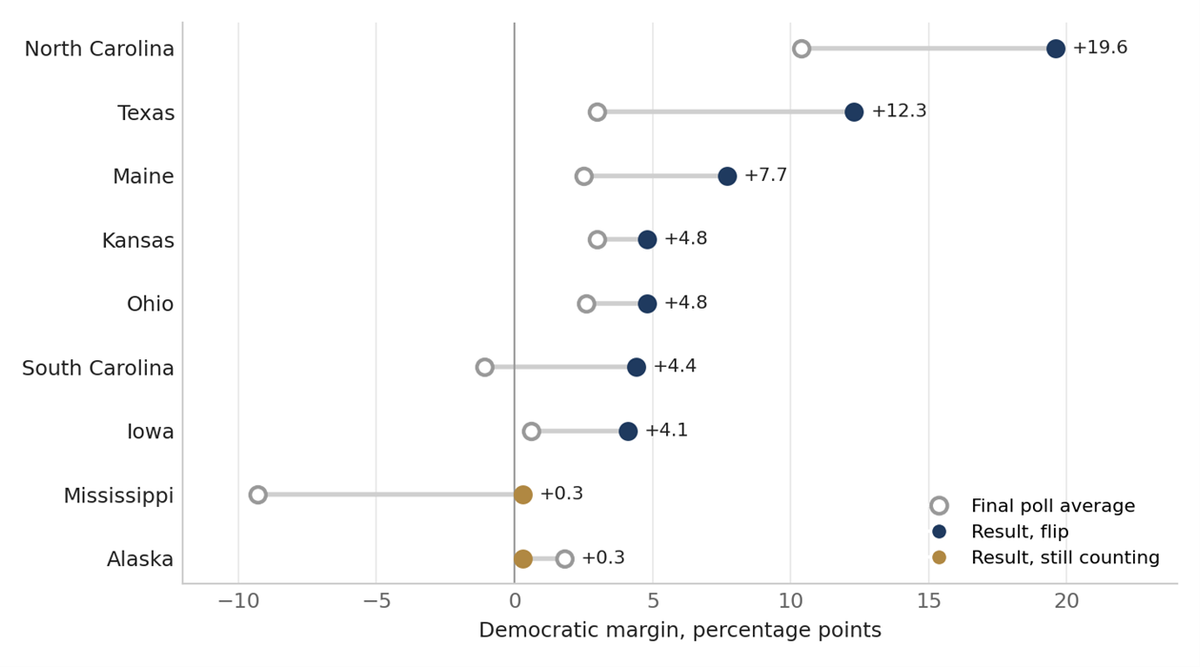
Democrats took the House comfortably, took the Senate with seven flips with two races still being counted, and won a majority of governorships for the first time in sixteen years. The direction was not a surprise with the generic ballot polling having Democrats ahead by around nine points leading up to election day and prediction markets putting the chance of a sweep at about three in four on the morning of the vote. What the polls and the markets missed was the size. The national House vote is running near thirteen points in the Democrats' favour (the largest midterm margin for either party since 1974) and across the eleven contested Senate races, the Democratic candidate beat the final polling average by about five and a half points. The miss ran the same way everywhere but Alaska, where Peltola ran behind her polls after late reporting on a second candidate named Dan Sullivan on the ballot, and Nebraska, where the independent challenger fell short. That is an environment error rather than a collection of local surprises. One explanation is that pollsters, having overstated Democrats in past cycles, converged on one another, and that kind of herding shows up as a miss in the same direction (Figure 1).
FIGURE 1: Senate pickup targets, final polling margin versus result (percentage points, Democrat less Republican)
(Source: PollCheck final averages, NBC News, Viewpoint calculations)
A Wave Built From the Centre
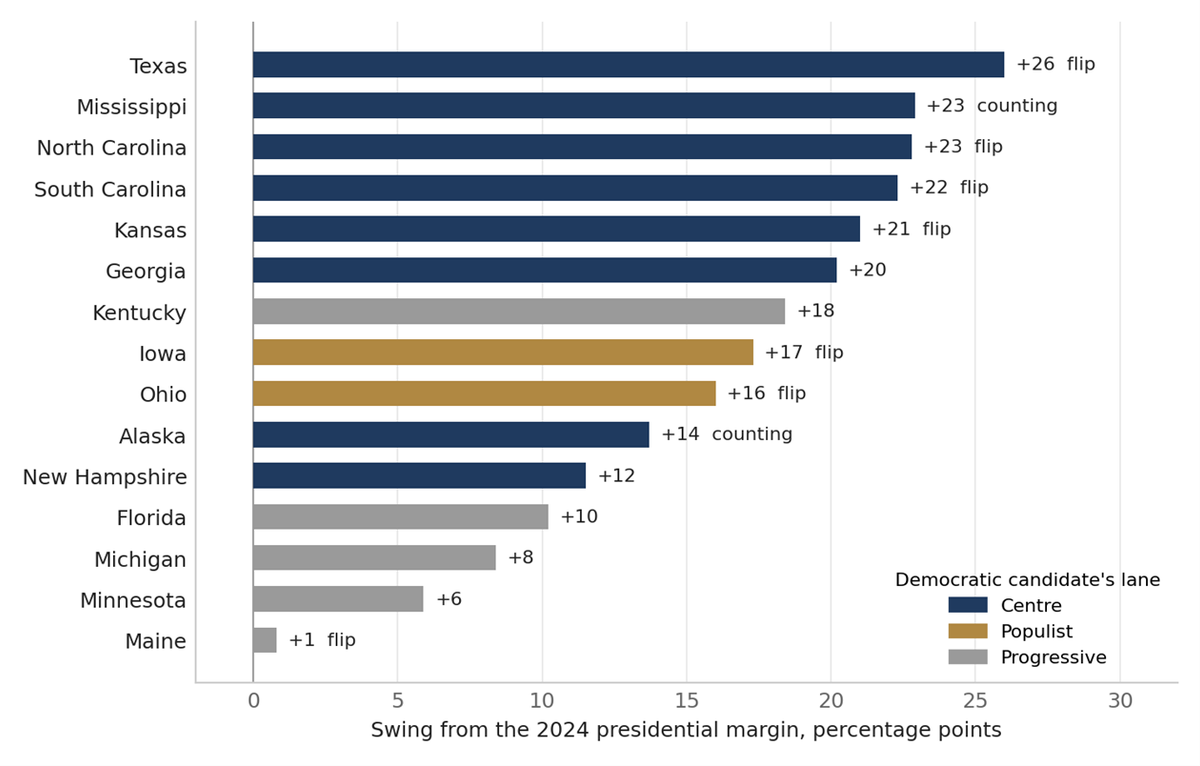
The cleaner way to discern the style of the Democratic win is not against the pre-election polls, which nearly every Democrat beat, but against the 2024 Presidential result in each state, which is the baseline the environment moved from (Figure 2). On that measure, five of the seven Senate flips came in states Trump carried by eleven to eighteen points, and the swings there ran from sixteen to twenty-six points. Three of those five were won from the centre, by James Talarico in Texas, Adam Hamilton in Kansas, and Annie Andrews in South Carolina. Two were from the economic-populist lane, by Sherrod Brown in Ohio and Josh Turek in Iowa, where campaigns were run on trade and wages rather than the progressive social agenda. Roy Cooper's win from the centre in North Carolina, a state Trump carried by three, swung by more than twenty. The progressive lane produced one flip, in Maine, and Maine is the state on the map that moved least. The House tells the same story, with the party's democratic-socialist wing winning safe seats in New York and Denver, while the swing-seat gains came from the centrist lane.
FIGURE 2: Swing from the 2024 Presidential margin to the 2026 Senate result, by candidate lane (percentage points)
(Source: NBC News, state election results, Viewpoint classification and calculations)
Against the polls, the progressive candidates did not run behind the environment, but against the 2024 map they did. The cleanest test is Florida, because its baseline matches the red-state flips. Angie Nixon ran as a democratic-socialist, to the left of the progressive lane, on Medicare for All and a national rent freeze, and took a state Trump carried by thirteen to within three points of Ashley Moody, a swing of ten. Talarico, Hamilton, and Andrews started from baselines within five points of Florida's, swung twenty-one to twenty-six, and won. In the blue states, Abdul El-Sayed in Michigan and Troy Jackson in Maine both beat their polls, but Michigan moved only eight points from its 2024 result and Maine less than one, against a national swing of around fourteen and twenty in Georgia. We would not overstate the point, since Florida's Republican registration edge has grown by about half a million voters since 2024, and in Maine Susan Collins has long drawn votes from Democrats who would not back another Republican, which kept that race closer than the national swing alone would suggest. Even so, the fair read is that the progressive candidates captured a third to a half of the environment where the centrists captured all of it, and that Florida is as close as the map comes to showing what Texas would have looked like with a progressive on the ballot.
Turnout strengthens that read, at a shade under fifty percent, the second-highest midterm turnout since 1914. The electorate also included a smaller proportion of 2024 Trump voters than in 2024, a shift that accounts for roughly a third of the movement in the national House vote. The rest was persuasion, and broad persuasion, with the largest contributions coming from white college graduates and independents, two of the biggest voting blocs, who moved from a single-digit to a double-digit Democratic margin. The marginal voter this cycle was a suburban, college-educated independent voting on prices, on the war, and on the President, not a newly mobilized progressive constituency, and a persuasion wave tends to be more durable into the next election than a turnout wave, which reverses when the other side comes back out.
What that means for 2028 is less tidy than either wing would like. The result was first a rebuke of the party in power, and a midterm rebuke does not come with a mandate attached. Democrats now have a big tent rather than a cohesive message, with centrists holding the new seats in the South and the Plains, economic populists the industrial Midwest, and progressives the Northeast and the safe metropolitan districts. Most of the candidates who turned forty-seven seats into fifty-four ran to the middle, most of them in states that voted for Trump by double digits, which fits the Clinton template we described in October of a centrist Democrat checked by the other party. California voters cut the same way, rejecting the billionaire wealth tax on their ballot and passing a measure that bars a future one, which takes one of the progressive wing's marquee revenue ideas off the table in its own home state.
The Republican side is reading the same evidence. The morning after the election, Vice President Vance posted that the party lost because of the war, and that the way back ran through ending it, the cost of living, putting America first, and the relationship with Israel. The President called the assessment largely true while standing by the decision and arguing that gasoline prices and his own absence from the ballot mattered more. The exchange was the first visible distance between the two men, which matters for a 2028 Republican field that was supposed to be the Vice President's to lose. It is also a statement of where Republican strategy goes from here, which is to win back the suburban, college-educated voters who defected on the war and on prices rather than to run against the progressive left. Financial markets took the second reading, with crude oil falling as the odds of a post-election escalation with Iran faded. Gridlock may turn out to be less absolute than the veto arithmetic suggests, with issue-by-issue coalitions on the war and on affordability that did not seem available a week ago.
A Bipartisan Backlash Against the Build-out
Data centres have become one of the rare issues that unites voters across party lines, and the midterms confirmed it. Two-thirds of Americans oppose one being built in their own community, and a majority of midterm voters told the exit poll that AI will hurt society more than help it. Reading those numbers, both parties ran against an unchecked build-out. Greg Abbott halted new permits in Texas pending an audit, Vivek Ramaswamy offered free electricity to neighbours of data centres in Ohio, Kathy Hochul signed the first statewide moratorium in New York, Josh Shapiro ordered developers in Pennsylvania to fund their own power, and Gina Hinojosa ran in Texas on stopping construction outright.
There is also a quieter cost that we have written about before. The build-out is financed with hundreds of billions of dollars of new debt that competes with governments and with home buyers for the same pool of savings, which, as we see it is one more reason long rates and mortgage costs stay higher than the housing market would like. Martin Wolf made the point in the Financial Times recently that the hyperscalers' capital spending will exceed their operating cash flow this year for the first time. Our colleague Amin Haji, in Viewpoint research to be published shortly, shows that in the third quarter three of the four largest spenders put more into capital spending than their operations generated, and as a group they swung from a surplus of more than sixty billion U.S. dollars a year earlier to a shortfall of more than twenty-five, with the gap filled by outside financing while buybacks fell.
The AI Infrastructure Pipeline: Texas, Ohio, Georgia
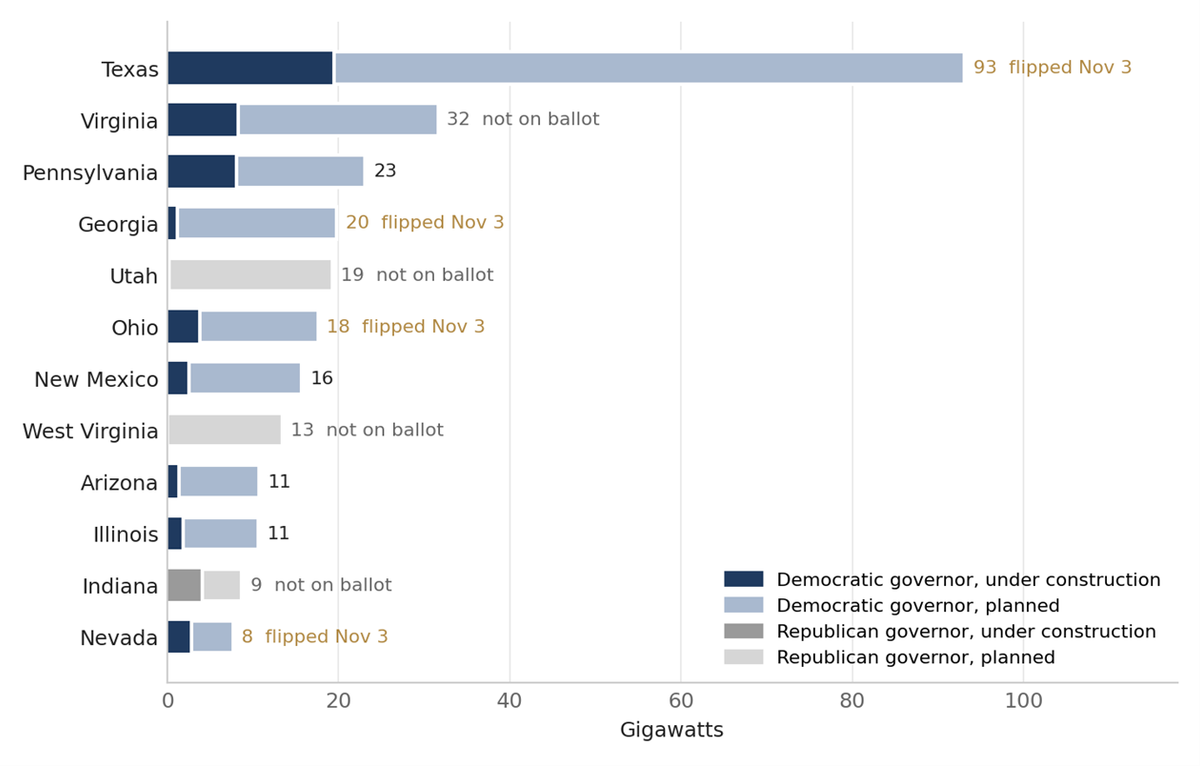
Every top-pipeline state on the ballot now has a Democratic governor who campaigned on making data centres pay their own way, a year after Virginia set the template (Figure 3). Texas matters most, because it has the largest construction pipeline in the country, about a quarter of planned national capacity, and Hinojosa ran on an immediate moratorium. Her formal power runs through utility-commission appointments, permitting, the veto, and the agenda of the session that opens in January. The Texas Senate held for the Republicans, but Democrats took the Texas House for the first time in more than two decades, and Vikki Goodwin took the Lieutenant Governorship from Dan Patrick, an office that sets the Senate's agenda. A statutory moratorium still has to pass a Republican Senate, but slower approvals and a tougher large-load tariff are close to a moratorium for new projects. The state data behind Figure 3 shows that the four flipped states in the chart hold about two fifths of the planned U.S. data-centre pipeline.
FIGURE 3: Data-centre pipeline by state, under construction and planned, coloured by the party of the governor after November 3 (gigawatts)
(Source: dcmap.us, October 2026; state election results; Viewpoint calculations)
Georgia is the quieter story and may prove the more consequential one, because the state's utility commission flipped alongside the governorship, so both the executive and the regulator that approves large-load contracts now sit with the party that ran on affordability.
Capacity that cannot be sited in Texas gets built somewhere else, and the Gulf, the Nordics, and Canada are the destinations. Alberta has been courting exactly this load since its data-centre strategy in late 2024, with no subsidies on offer and a bring-your-own-generation law passed last year. In July, Meta chose Sturgeon County, north of Edmonton, for a thirteen-billion-dollar, one-gigawatt campus, its first in Canada. But the politics we just watched in Texas are already here. In August, the Alberta Utilities Commission turned down the gas plant meant to power a proposed data-centre complex in Olds, finding it too close to the town, and the province's first town halls on its strategy, in Lacombe and Redwater, met the minister with jeers rather than applause. Alberta's version of the constraint runs through the utility regulator and municipal zoning rather than a governor, but it points the same way: toward projects that bring their own power and sit far enough away from communities. As we see it, that makes the province a beneficiary of capacity pushed out of Texas only at the margin, and for readers in Alberta a 2027 story worth following.
Equity Beta on Gridlock, Quality, and Value for Defence
We have favoured equity beta through quality and value over a cap-weighted global index for a year now, since Laying the AI Rails last November argued for rebalancing some growth holdings toward a quality and value tilt. The argument has not changed, which is that cap-weight has become a concentrated bet that the AI capex cycle pays back. The election added a political discount to the deliverability of that capex in the states where most of it is being built, and the first session after the election priced the rotation we would expect, with the Dow and the equal-weight index leading and the Nasdaq-100 closing up less than one percent against more than one and a half for the S&P 500.
The election result is unlikely to affect all AI-related names equally, since they carry different exposures to the same siting constraint. Developers, the neocloud builders, and merchant power in Texas own the permit and the interconnect, so they carry any project delay directly. In our view, hyperscalers with capacity already built or permitted sit on the other side of it. A slower build means higher utilization and pricing on what already exists, and a forced glide in capital spending slows a build-at-all-costs mentality that has been absorbing all of their operating cash flow and then some, turning a leverage story back into a free-cash-flow story. Semiconductor makers sell directly into that capital spending, so they feel the slowdown, though it should favour the most power-efficient chips, which would earn a larger share of a smaller pool.
Wednesday’s price action was consistent with that read, with the largest cloud platforms higher on the day and the data-centre builders, power producers, and semiconductors lower. As we see it, the case for rebalancing some exposure away from cap-weight becomes more specific and stronger. A selection process built on quality, value, and sustainable shareholder yield, with risk balanced across sectors, should, as we see it, carry little of the capex beta, which is exactly where cap-weighted indices are concentrated. On Thursday, the next day, the semiconductor selling returned and the hyperscaler bid did not, and what had been a rotation inside the AI complex became a day when everything sold. The Nasdaq-100 fell more than six percent, its worst day since March 2020, the semiconductor index fell twelve, and every sector closed lower. The dispersion still showed up. The equal-weight S&P 500 fell about a point and a half less than the cap-weighted index, and utilities, staples, and low-volatility stocks held up best.
We would not read much into one session, since positioning did a good deal of the work and futures were higher the next morning. But inside two days the narrative swung from a shortage of compute, which rewards whoever already has it, to a roadblock on the build-out, which hits everyone whose business depends on it going ahead. In the same week, ING put half a billion dollars of data-centre loans up for sale, including a slice of the Stargate site in New Mexico. That is the political discount on deliverability being priced into the capex beta in a hurry, and, as we see it, the clearest demonstration yet of where the concentration risk in a cap-weighted index sits. Amin's work puts a number on it, showing that thirty-six AI-themed companies, about seven percent of the names in the S&P 500, carried roughly three-quarters of its estimated risk at the end of October. On the Thursday after the vote their correlation with the rest of the index more than doubled, which is how a selloff in the capex beta becomes a selloff in the index. His work also shows that on the forty-four days in 2026 when semiconductors fell hard and lagged the market, the equal-weight index beat cap-weight on thirty-seven but made money on only sixteen, while shareholder-yield and quality-dividend ETFs beat the S&P 500 on nearly all of them.
The risk to the call is the mirror image. If the capex narrative shrugs off the state politics and gridlock relief broadens back into mega-cap, a quality and value construction would lag cap-weight, but as we see it, the case for diversification in equity beta is stronger at this point in the cycle.
Gridlock, Volatility, and the Fiscal Path
Fiscal gridlock is what was on the market’s mind the morning after the election, and, barring a shock, should be the playbook for the next year. The S&P 500 has been higher twelve months after every midterm since 1950, with an average gain in the mid-teens, and the pattern has held whether the result produced divided or unified government. Treasuries rallied with the belly leading, crude fell eight percent as the market read the result as putting pressure on the administration to end the war. The dollar slipped and yields fell, with no political term premium added, as we expected in October.
As we see it, the near-term volatility is likely to be procedural rather than directional. The stopgap that has funded the entire U.S. government since the fiscal year began in October runs out on December 11, and a Republican lame-duck Congress wants to lift the debt ceiling now rather than hand the Democrats that lever next spring, though thin margins and its own fiscal hawks make that a harder vote than the incentive suggests. If the ceiling is not lifted, it binds around May of next year, with the real deadline near the start of 2028, and it is not out of the question that a Democratic Congress facing a Presidential veto tests both dates. That is a recipe for episodic volatility around deadlines, rather than a change in direction.
On the dollar, our read is that it has been the AI trade all along, expressed through yields on the back of economic strength, so if part of the build-out stalls, the dollar is more likely to be flat to weaker than stronger. On Thursday, the Treasury curve bull-steepened with the front end leading as the market trimmed the odds of a December rate rise, while the U.S. dollar barely moved, which is what we would expect if the build-out has been carrying both rates and the dollar. Friday's payroll report calmed some of the worry about a broader slowdown in the U.S. economy, with hiring coming in well ahead of expectations, which firmed up a December rate rise as the market's base case. As long as the labour market holds, so does the support for U.S. rates and the dollar, which is the same condition we attach to our duration view.
On the fiscal side, gridlock should be the status quo for the next two years, and it is too early to form expectations for the 2028 election cycle or what it would mean for the deficit. The Democratic agenda as written adds close to one percent of GDP a year to the deficit but cannot pass a veto, so for the next two years our base case is no new fiscal thrust. The path after that depends on who takes the White House in 2028 and whether Congress aligns with the President, and which wing of either party wins its nomination is the question we want answered before we change our call on long-end duration. For now, the composition of the majority argues for the centre, and in our view the centre, checked by the other party, is the configuration behind the meaningful fiscal consolidations of the past forty years.
What It Means for Portfolios
Pooled funds. Viewpoint Investment Partners' pooled funds allocate capital through a rules-based, systematic framework. The views in this letter do not change how the funds are positioned.
Separately managed accounts. For Viewpoint Private Wealth clients in separately managed accounts, our portfolio managers apply these house views at their discretion when they make allocation decisions. The election reinforces rather than changes our house view. Our house view remains to prefer equity beta through quality and value over a cap-weighted global index, and we feel the political discount on the AI build-out makes that preference more important. The modest duration we added in the belly of the U.S. curve, which took us to neutral duration, stays, as does the steepener position, as discussed in our third quarter commentary, and we remain underweight international duration. The AI wobble has not reached the labour market yet, but if the real economy starts to crack on a slowdown in the build-out, we will reassess both the duration and the curve view. Commodity exposure remains structural rather than tactical, though the result does dent the parts of the complex most tied to data-centre construction, and copper gave back two to three percent over the week. Crude has fallen as the market prices a wind-down in the war with Iran, but a war winding down is not the same as a less fragmented world, and we do not think there is enough evidence yet to support that view. Gold rallying as the dollar's growth premium was questioned is a good reminder of why we hold breadth within a diversified commodities portfolio.
In a multipolar world where the political centre is under pressure across developed democracies, the American electorate just handed a majority to the candidates who ran toward it, and the bond market, for one morning at least, said thank you.
Happy investing!
Scott Smith
Chief Investment Officer
This commentary is published by Viewpoint Investment Partners Corporation (VIPCo) and Viewpoint Private Wealth (VPW) for their clients, investors in VIPCo's pooled funds, and prospective investors. It is for general information only. It is not investment, tax or legal advice, and it does not consider the objectives or circumstances of any individual reader. The views expressed are those of the authors as of October 2026 and may change without notice.
Separately managed accounts. VPW portfolio managers apply these house views at their discretion in separately managed accounts. The positioning described in this letter refers to those accounts. It varies by account, based on each client's objectives, risk tolerance, liquidity needs, tax circumstances and investment restrictions. A suitability assessment is completed before an account is opened.
Pooled funds. VIPCo's pooled funds allocate capital through a rules-based, systematic process. The views and positioning in this letter do not determine the funds' holdings. This letter is not an offer or solicitation to buy securities of any fund. Fund securities are offered only through the applicable prospectus or offering memorandum, and some funds are available only to investors who qualify under a prospectus exemption, such as accredited investors. Commissions, trailing commissions, management fees and expenses all may be associated with mutual fund investments. Please read the prospectus before investing. Mutual funds are not guaranteed, their values change frequently and past performance may not be repeated.
Statements about future events are opinions, not guarantees. Past performance and historical market patterns do not guarantee future results. All investments involve risk, including possible loss of capital. Third-party information is believed to be reliable but has not been independently verified and is not guaranteed. VIPCo, VPW, their affiliates, their clients and the funds they manage may hold positions in the securities or sectors discussed.